Dangote Refinery IPO Tests Push to Build an African Fuel Platform
AI Writer·September 5, 2026·7 min read·AI-generated
Reuters via MarketScreener
news
Nigeria's Dangote seeks around $1.5 billion with refinery IPO, sources say
“Dangote Group plans to price the refinery IPO at 525 naira per share, potentially raising about $1.5 billion, with proceeds helping fund a capacity increase to 1.4 million barrels per day.”
Reuters via Citizen Digital
news
Nigeria's Dangote to hold Lamu Oil Refinery Groundbreaking ceremony in September
“Dangote said the Lamu refinery would be launched on September 30 and developed with East African governments to supply Kenya and neighboring countries.”
The Star Kenya
news
Dangote to break ground for Sh2.2trn Lamu oil refinery on September 30
“The proposed Lamu refinery is planned at 700,000 barrels per day and is intended to reduce the region’s dependence on imported fuel.”
$1.5B IPO
Dangote Group is reportedly seeking about $1.5 billion from a refinery IPO priced at 525 naira per share.
1.4M bpd
IPO proceeds are expected to support a plan to double the Lagos refinery’s capacity to 1.4 million barrels per day.
Lamu launch
Dangote has set September 30, 2026, for the groundbreaking of a planned 700,000-barrel-per-day refinery in Lamu, Kenya.
Dangote Group is preparing to ask public investors to fund the next stage of its refining expansion, with a planned IPO of its Nigerian refinery unit that could raise about $1.5 billion and help finance a capacity increase from 650,000 barrels per day to 1.4 million barrels per day.1
The proposed listing, reported by Reuters on September 4, is central to a broader strategy: turning the privately built Lagos refinery from a single megaproject into the anchor of a continent-scale refining and capital-markets platform. The next visible step is outside Nigeria. Aliko Dangote has said the group will hold a groundbreaking ceremony on September 30 for a planned refinery in Lamu, Kenya, its biggest refining investment beyond its home market.2
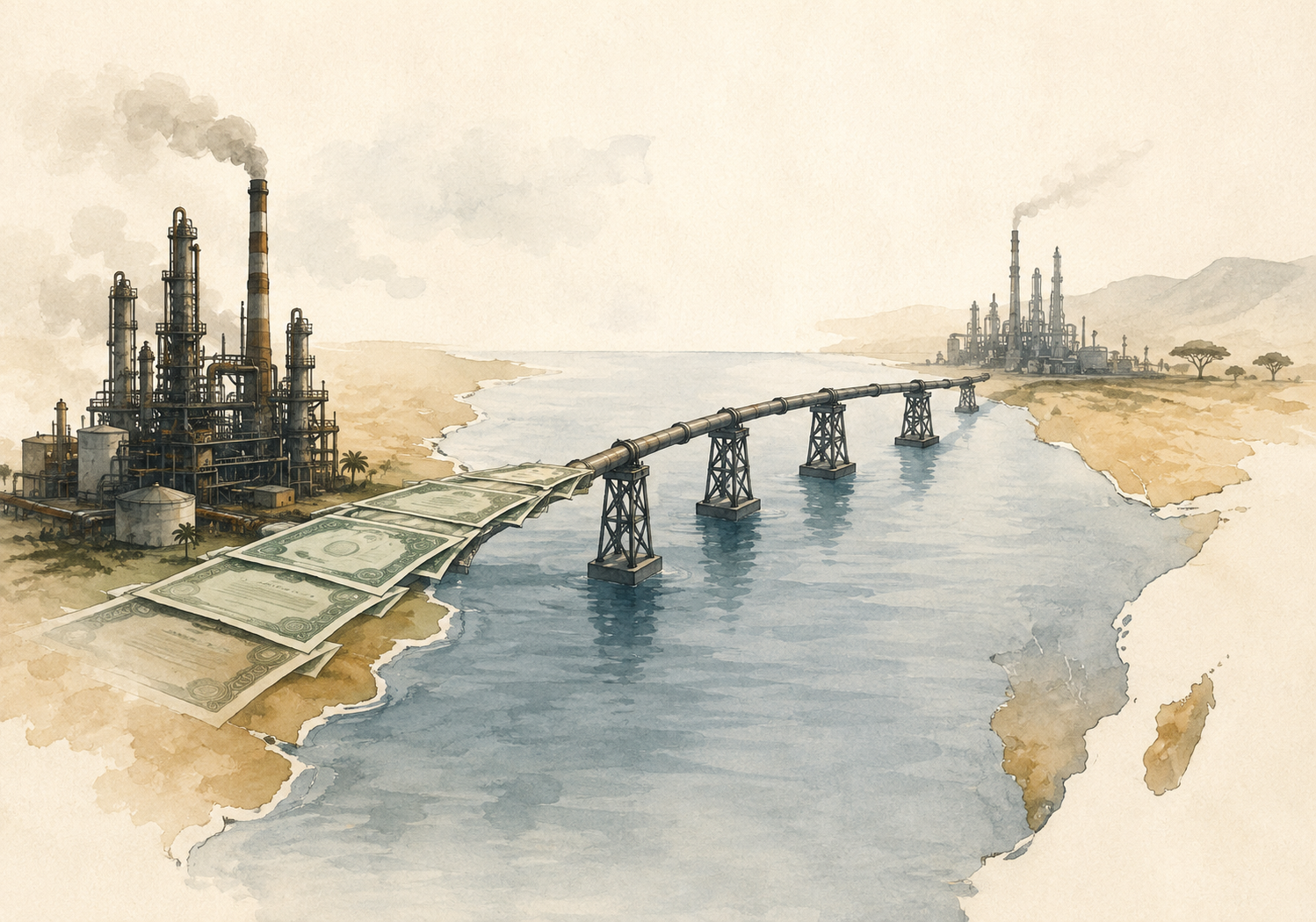
Together, the IPO and the Kenya project point to a shift in Dangote’s energy ambitions. The group is no longer only trying to solve Nigeria’s chronic shortage of domestic refining capacity. It is trying to build a regional downstream network that can process crude closer to African consumers, deepen local capital markets and reduce dependence on imported refined petroleum products across West and East Africa.3
The IPO terms reported by Reuters suggest Dangote is seeking to broaden ownership of the refinery while preserving the growth story that made the Lagos plant one of Africa’s most watched industrial assets. The offer is expected to be priced at 525 naira per share, with the company planning to sell 4.1 billion shares. Reuters reported that the order book is set to open on September 14 and that the offer could include a 15% greenshoe option if demand is strong.1
For investors, the core question is whether the refinery can justify a public-market valuation built around scale, strategic scarcity and regional export potential. Reuters reported that a July private placement indicated a $40 billion valuation for the refinery, while noting that some investors and analysts considered that rich compared with listed refiners elsewhere.1
For Dangote, the rationale is clear. Public markets can provide recurring capital for an asset class that requires large upfront spending, long development timelines and complex logistics. Nairametrics reported that the proceeds are expected to support the capacity-doubling plan, while also framing the Kenya refinery as part of a wider African refining strategy.4
That makes the planned listing more than a liquidity event. It is a test of whether African equity markets can finance industrial infrastructure at a scale usually reserved for sovereign balance sheets, development lenders or global energy majors.
The Lagos refinery has already changed the strategic map for Nigeria, Africa’s largest oil producer but historically a major importer of refined fuels. At 650,000 barrels per day, the plant was designed to reduce Nigeria’s reliance on imported petrol, diesel and jet fuel while creating a platform for refined-product exports into neighboring markets.1
The planned expansion to 1.4 million barrels per day would push that logic further. A refinery of that scale would not be built only for Nigeria’s domestic demand. It would be designed as a regional supply machine, able to serve African markets that still import large volumes of finished fuels from Europe, the Middle East and Asia.
The Lamu plan applies the same model to East Africa. Reuters, via Citizen Digital, reported that the Kenyan refinery is expected to supply Kenya and neighboring countries and help reduce East Africa’s reliance on imported fuels.2 The Star Kenya reported that the proposed Lamu plant would have capacity of 700,000 barrels per day, making it the largest refinery in East Africa if completed.3
That matters because East Africa’s fuel systems are shaped by import logistics, port capacity, foreign-exchange availability and exposure to global refining margins. A large refinery on Kenya’s coast could alter that structure by placing processing capacity closer to end markets in Kenya, Ethiopia, Rwanda, Uganda and the wider region.
The strategic pattern is becoming clearer. Dangote appears to be using Nigeria as proof of concept, the IPO as a financing mechanism and Kenya as the first major replication market.
The Lagos refinery gave the group operating credibility in a sector where African governments have often struggled to build or maintain large refineries. The IPO would expose the asset to public-market discipline while potentially allowing African institutional and retail investors to participate in its economics. The Lamu project would then show whether the model can travel across borders and adapt to a different regional demand center.
The Star Kenya reported that Lamu was selected after Dangote Industries considered other East African locations, including Tanzania, and that preliminary work such as site selection, soil testing, engineering and design had begun by July.3 The report also said the wider development could include storage, logistics, energy and manufacturing facilities, suggesting a broader industrial cluster rather than a standalone refinery.3
If that structure materializes, Dangote would be pursuing a vertically and geographically scaled platform: crude processing, fuel distribution, export logistics and associated industrial infrastructure tied to regional economic corridors.
The ambition is large, but so are the execution risks. Refineries are capital-intensive, exposed to commodity cycles and vulnerable to cost overruns, delays, regulatory shifts and feedstock-supply problems. The Lagos refinery itself required about $20 billion to build, according to Reuters.1
The Kenyan project raises additional questions. It would need alignment among national governments, lenders, equity partners, port authorities and fuel distributors. The Star Kenya reported that East African countries have been offered a combined 30% stake in the refinery and associated project, with Kenya offered a 10% stake valued at about $500 million.3
That regional ownership structure could help secure political support and demand commitments. It could also complicate governance. Cross-border infrastructure projects often move slowly when participating governments have different fiscal constraints, election cycles and strategic priorities.
The IPO also carries market risk. A successful offer would signal that investors are willing to back African heavy industry at scale. A weak reception would raise questions about valuation, transparency and the depth of local capital markets for projects of this size.
The planned IPO comes as African governments and companies seek ways to finance industrial expansion without relying entirely on foreign debt. If Dangote can raise $1.5 billion from public investors, the transaction could become a benchmark for large African infrastructure-related listings.1
It could also create a new investable category: African downstream energy infrastructure with regional export exposure. That would appeal to investors looking for assets tied to population growth, transport demand and industrialization, while still carrying the cyclical risks of refining.
The strategic promise is that African markets can capture more value from oil consumption by refining closer to home. The risk is that scale alone does not guarantee returns. Margins depend on crude supply, product pricing, logistics efficiency, regulation and competition from established global refiners.
Dangote’s plan is ultimately a test of whether a privately led African industrial group can build, list and replicate refinery assets across the continent.
The Lagos refinery proved that a single African company could deliver a project of exceptional scale. The IPO will test whether public investors are prepared to finance its next phase. The Lamu refinery will test whether the model can become regional.
If all three pieces come together, Dangote would move beyond owning Africa’s largest refinery. It would become the operator of a refining network funded partly by public equity and designed to reshape the continent’s fuel supply chains.

GE Aerospace’s agreement to buy Consolidated Precision Products is more than a supplier acquisition: it is a vertical-integration bet on scarce casting capacity. The transaction shows how engine makers are treating manufacturing choke points as strategic assets as commercial, aftermarket and defense demand strain aerospace supply chains.

Enel’s attempt to stop a Brazilian revocation proceeding shows how grid resilience failures can move from operational controversy to a direct threat to market access. For global utilities, storm response is becoming a core license-to-operate issue, not only a performance metric.

SoundHound AI completed its acquisition of LivePerson on September 4, combining voice and agentic AI with enterprise messaging infrastructure and appointing former LivePerson executive John Collins as CFO. The deal reflects a broader shift in customer-service AI from standalone tools toward unified platforms spanning voice, messaging, orchestration, data and enterprise accounts.

Bending Spoons completed its all-cash acquisition of Airtable on September 4, giving the newly listed Italian software consolidator a high-profile test of its operating model. The challenge is whether it can improve growth and profitability at a widely used workflow platform without undermining customer trust.
Initial public offering
An IPO is the first sale of a company’s shares to public investors, often used to raise capital and create a market valuation.
Greenshoe option
A greenshoe option allows underwriters to sell additional shares, usually up to a set percentage, if investor demand exceeds the original offer size.
Barrels per day
Barrels per day, or bpd, is the standard measure of how much crude oil a refinery can process in a day.
Import substitution
Import substitution is a strategy in which a country or region replaces imported goods with locally produced alternatives.





Comments