Disney TV overhaul would pressure legacy network silos
Linear TV
Traditional scheduled broadcast and cable television, as opposed to on-demand streaming.
Brand silos
Separate teams or divisions organized around individual networks, studios or channel brands.
Franchise monetization
Using intellectual property across multiple businesses, including streaming, film, merchandise, games, parks and live experiences.
Streaming bundle
A subscription package that combines multiple streaming services, such as Disney+, Hulu and ESPN, under one offer.
Hundreds at risk
Disney’s reported TV restructuring could include hundreds of layoffs and division consolidation.
Exposed units
ABC Entertainment, 20th Television, Hulu Originals, Freeform, National Geographic Content, Disney Kids & Family and ABC News are among the units identified in reports.
Streaming shift
The reorganization would move Disney TV away from linear brand silos and toward streaming audience priorities.
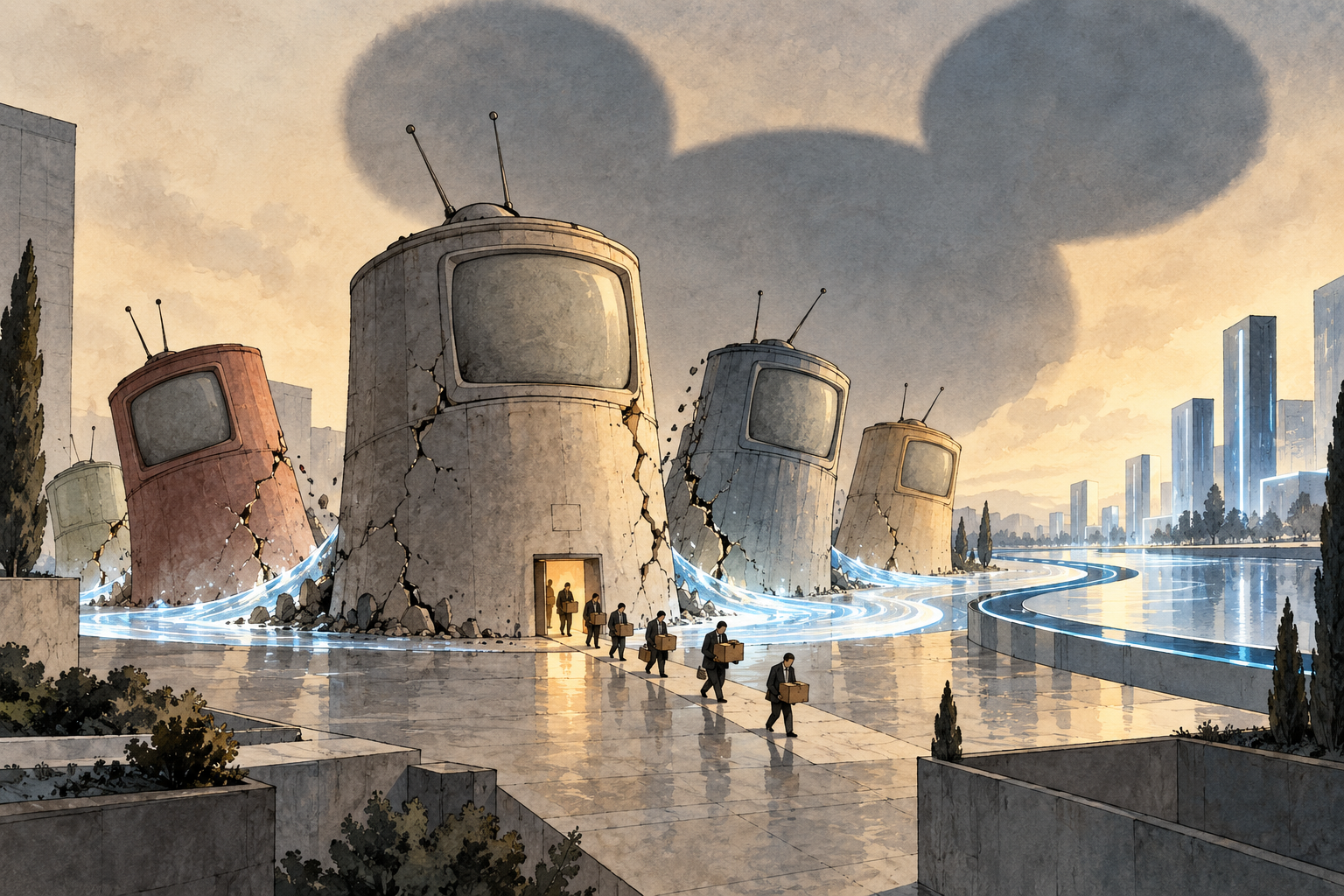
Disney is reportedly preparing a restructuring of its television operations that could eliminate hundreds of jobs and consolidate divisions, signaling another move away from legacy broadcast and cable structures toward a centralized, streaming-first operating model.1
The plan, reported by The Wall Street Journal and cited in a Reuters October 2 press digest, is still being finalized and may not be completed before year-end, according to subsequent reports. Reuters said it had not independently verified the Journal items in its digest.1 The restructuring is being led by Debra O’Connell, chairman of Disney Entertainment Television, and is expected to affect units that have historically operated around distinct network, studio and platform brands.2
For media executives, the significance is less the headline number of possible job losses than the management signal. Disney appears to be rebuilding television around fewer layers, fewer brand-based teams and closer alignment with streaming demand.
The reported reorganization would shift the organizing principle from linear TV brands to streaming audiences. That change puts the most pressure on divisions with overlapping mandates across development, programming, marketing and executive oversight.2
The units most directly identified as vulnerable are within Disney Entertainment Television’s content and network architecture. Quartz, citing the Journal report, named ABC Entertainment, 20th Television, Hulu Originals, Disney Kids & Family, National Geographic Content and Freeform among the businesses under O’Connell’s purview that could be affected. ABC News also faces additional reductions.2
Indian Television Dot Com similarly reported that the restructuring is expected to affect executives running ABC Entertainment, 20th Television, Hulu Originals and Freeform.3 Those units sit at the intersection of three pressure points: traditional linear programming, streaming content supply and a corporate push to reduce duplicated decision-making across brands.
ABC Entertainment and Freeform are most exposed to the erosion of channel-based economics because their historical value is tied to schedules, brands and distribution models built for linear television.
20th Television and Hulu Originals face a different kind of exposure. They remain central to content creation, but the restructuring raises questions about how many separate development pipelines Disney needs when programming decisions are increasingly measured against cross-platform value rather than single-channel performance.
National Geographic Content and Disney Kids & Family also face the logic of consolidation. Both have strong brand identities, but both operate in categories where Disney can distribute programming across linear channels, Disney+, Hulu and international platforms. That makes them strategically important, but also vulnerable to folded reporting lines and shared services.
ABC News is a separate but important case. News remains a core broadcast asset, but reports of additional reductions indicate that even differentiated live and news operations are not insulated from the broader effort to lower fixed costs and reduce layers.2
The reported overhaul comes as media companies continue to manage the decline of high-margin cable and broadcast economics, while streaming has not fully replaced the profit pool of the traditional bundle. Indian Television Dot Com framed the industry backdrop as cord-cutting reducing once-lucrative cable and broadcast networks while streaming has yet to offset those lost profits.3
Disney’s management rationale has been stated more directly by Dana Walden, Disney’s president and chief creative officer. Speaking at Bloomberg Screentime on October 1, Walden described recent layoffs as “extremely painful” but necessary as the company competes with technology and streaming rivals.4
AFP reports carried by Business Recorder quoted Walden saying there is a need to “constantly evaluate” corporate structure, and reported that more than 300 recent cuts were concentrated in human resources and information technology.5
That language closely matches the logic of the television plan. The restructuring is not simply a cost exercise. It is a governance change.
A streaming-led business requires faster decisions about which shows deserve investment, where they premiere, how they are marketed and how they support broader Disney intellectual property. Separate brand silos can slow that process and duplicate functions.
The reported TV changes would follow several rounds of workforce reductions across Disney. Business Recorder reported more than 300 layoffs this week, largely in HR and IT, after about 1,000 April cuts primarily in marketing.5
Pirates & Princesses, summarizing Disney’s 2026 layoff rounds, said earlier reductions also touched ESPN, National Geographic and Pixar. It described the late-September HR and technology cuts as Disney’s third round of job cuts in 2026.7
That sequence matters because it shows Disney cutting both central functions and content-adjacent operations. For executives across the industry, the pattern suggests companies are not only trimming underperforming divisions. They are redesigning the operating system of legacy media companies for a market in which scale, data, bundles and franchise extension matter more than maintaining separate channel identities.
The television restructuring also fits with Disney’s broader strategic pivot. Bloomberg, via Mint, reported that Disney operates Disney+, Hulu and ESPN streaming services, sells them in a bundle and integrates programming across them.6 The same report said Disney has described a future digital experience that connects merchandise, games, experiences, films and television, beginning in spring 2027.6
That context helps explain why television units are being reorganized now. In Disney’s model, the value of a show increasingly extends beyond a single network run or streaming debut. The company is trying to turn content into a broader consumer relationship that can support subscriptions, merchandise, parks, games and live experiences.
Walden’s comments about “Bluey” illustrate that franchise logic. She said Disney would be interested in owning the intellectual property if the opportunity arose, while noting the company already benefits from the show through distribution, merchandise presence and theme-park appearances even though it does not own the property.6
For Disney, ownership and control of franchise IP can make television programming more valuable across the company’s full ecosystem.
Sports occupies a related but distinct position. ESPN has seen cuts, according to reports tracking Disney’s 2026 reductions, but sports remains strategically important because live rights, streaming bundles and fan engagement can help support subscription value in a market where general entertainment is abundant.7
The likely implication is that sports functions will face pressure to integrate and operate efficiently, but not necessarily the same exposure as general-entertainment brand silos.
The key variables are whether Disney finalizes the television plan before year-end, how deeply it cuts executive layers, and whether the company combines development, programming and marketing functions across brands.
The most important signal will be whether ABC, Hulu, Freeform, National Geographic and studio operations retain distinct decision rights or become nodes in a more unified television and streaming organization.
If the reported plan proceeds, Disney’s television business will look less like a portfolio of legacy brands and more like a centralized content engine serving streaming, broadcast, sports and franchise priorities.
For the rest of the industry, the message is clear: the next phase of media cost-cutting is not just about fewer employees. It is about fewer silos.






Comments