Europe’s AI Sovereignty Gap Is Shifting From Processors to Memory
High-bandwidth memory
A type of advanced memory placed close to accelerators to move large amounts of data quickly, making it critical for AI training and inference.
DRAM
Dynamic random-access memory, the main working memory used by servers, PCs and many computing systems.
NAND flash
Non-volatile memory used for storage in devices, servers and solid-state drives.
Sovereign AI
The ability of a country or region to build, operate and govern AI systems with reduced dependence on foreign-controlled infrastructure and suppliers.
TechRadar
news
TVs are finally being hit hard by the AI-fueled memory crisis: for the first time, the cost of the processors is higher than the display panels in some models
Seoul Economic Daily
news
Memory Price Gains Slow Sharply, Raising Peak-Cycle Questions
Seoul Economic Daily
news
After Micron's Earnings Beat, Eyes Turn to Samsung and SK hynix
Memory gap
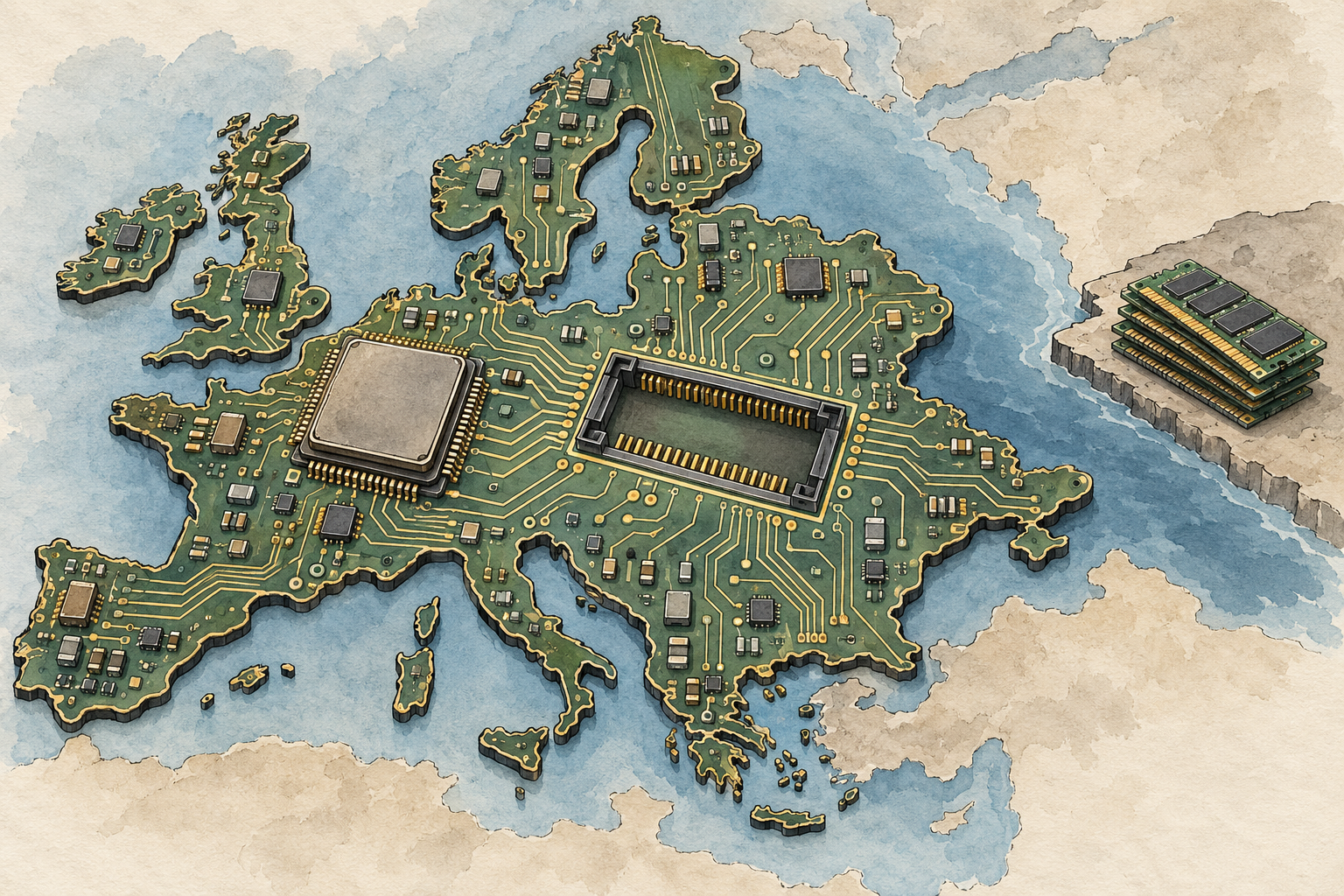
Europe’s supercomputing supply chain has improved, but memory remains the major component without a local supplier.
HBM pressure
TrendForce expects blended high-bandwidth memory prices to rise 121% in 2027 as HBM4 adoption and supply constraints continue.
Asian scale
Samsung plans about 360 trillion won in investment for its Yongin semiconductor cluster, underscoring the scale needed for chip supply-chain depth.
Europe’s next sovereign AI constraint may not be the processor. It may be memory.
That is the strategic implication of recent comments by Bull CEO Emmanuel Le Roux, who told Reuters that Europe can now source a much larger share of supercomputer components locally but still lacks a domestic memory supplier. For infrastructure executives, the issue reframes AI sovereignty: owning or sourcing processors is only one layer of control. If the memory that feeds those processors is scarce, expensive or controlled by a small group of overseas suppliers, European AI infrastructure remains exposed.
The concern comes as AI data center demand reshapes the global memory market. High-bandwidth memory, server DRAM and NAND flash are no longer peripheral cost lines. They are central inputs for accelerator clusters, model training, inference and supercomputing systems. Market reports show that AI-related demand is keeping memory supply tight, even as pricing momentum varies across product categories.2
The public debate around sovereign AI infrastructure has focused heavily on processors: graphics processing units, accelerators, central processing units and emerging European processor initiatives. That focus is understandable. Processors are visible, politically salient and directly associated with AI performance.
But supercomputers and AI clusters are systems, not chips. Memory determines how much data can be kept close to compute engines, how quickly models can access parameters and intermediate results, and how efficiently accelerators can be used. A powerful processor starved of memory bandwidth or capacity cannot deliver its theoretical performance.
That makes memory a strategic input, not a commodity. In supercomputing, large memory pools support simulation, scientific computing and data-intensive workloads. In AI, high-bandwidth memory, or HBM, is tightly integrated with advanced accelerators and is one of the hardest components to secure at scale. Independent infrastructure analysis of Nvidia Blackwell supply constraints points to tight HBM3E availability alongside advanced packaging constraints, with Micron, SK hynix and Samsung shipping into major accelerator platforms.7
Europe’s industrial strategy has sought to reduce dependence on non-European technology providers in critical digital infrastructure. Progress on boards, interconnects, cooling and processor initiatives helps. Yet memory is still dominated by a small set of global suppliers, particularly Samsung Electronics, SK hynix and Micron.
That concentration matters because AI demand is changing how memory capacity is allocated. Suppliers are prioritizing higher-margin HBM and server DRAM for data center customers, which can keep other memory markets tight even when consumer electronics demand softens. Seoul Economic Daily reported that TrendForce expects conventional DRAM contract prices to rise another 10% to 15% in the fourth quarter, with NAND flash up 15% to 20%, while strong AI server and cloud demand keeps suppliers focused on HBM and server DRAM.2
For European infrastructure buyers, the risk is not only price inflation. It is allocation. The largest cloud providers, accelerator vendors and AI labs can secure long-term supply agreements, sometimes years ahead. Smaller national supercomputing projects, public-sector AI programs and regional infrastructure providers may face longer lead times, weaker negotiating leverage and greater exposure to spot-market volatility.
Current market signals show that memory has become a proxy for AI infrastructure demand. Micron’s recent results and guidance beat expectations, with analysts pointing to continued demand not only for HBM but also for conventional DRAM and NAND used across AI systems.3 Samsung and SK hynix are now being watched as indicators of how durable the AI-led memory upturn will be.3
Samsung’s expected earnings illustrate the scale of the cycle. Analysts cited by Seoul Economic Daily expected the company’s third-quarter revenue to top 200 trillion won and operating profit to exceed 110 trillion won, which would mark quarterly records if realized.4 Separately, IBK Investment & Securities said Samsung’s memory demand was expected to hold up through next year, while TrendForce projected that blended HBM average selling prices could rise 121% in 2027 from a year earlier because of HBM4 adoption and continued constraints.5
That does not mean prices will rise in a straight line. Some categories are already showing slower gains. DDR4 and NAND price increases moderated in September, according to industry data cited by Seoul Economic Daily, raising questions about where the memory cycle may peak.2 But for sovereign AI planning, the more important point is that slower price increases can still coincide with high absolute prices, constrained supply and long-term capacity commitments to the largest buyers.
The memory squeeze is already visible outside the data center. TechRadar reported that AI-driven demand is contributing to component shortages and rising costs in televisions, with basic DRAM prices reaching about 4.4 times their year-earlier level and NAND flash nearly nine times higher.1 The report said processing boards in some smaller televisions now account for 45% to 50% of total cost, compared with just over 10% in the second quarter of 2025.1
For infrastructure executives, consumer electronics are a warning signal. If AI demand can disrupt low-margin, high-volume device markets, it can also complicate procurement for supercomputing centers and sovereign AI clouds. Memory is a shared supply chain. Public AI infrastructure, hyperscale data centers, enterprise servers, PCs, smartphones and embedded devices ultimately compete for overlapping production capacity, even if they use different grades and configurations.
The strategic gap is also about manufacturing ecosystems. Samsung has reaffirmed plans to invest about 360 trillion won, or roughly $260 billion, in a semiconductor cluster in Yongin, South Korea, with about 70 materials, parts, equipment and fabless firms expected to move in alongside the company.6 The project is not only a fab investment. It includes energy, water recycling and supplier clustering — the industrial base needed to support advanced semiconductor production at scale.6
That scale highlights the challenge facing Europe. Building memory capacity is not equivalent to funding a single chip design program. It requires process technology, fabs, materials, chemicals, equipment suppliers, packaging capability, skilled labor, utilities and long payback periods. Even if Europe launched new memory initiatives, meaningful supply would likely take years to reach the volumes needed for sovereign AI and supercomputing deployments.
The practical response is to treat memory as a first-order capacity-planning variable. AI infrastructure buyers should evaluate memory supply risk alongside accelerator availability, power, cooling and networking.
That means scrutinizing HBM roadmaps, DRAM supply agreements, packaging dependencies and supplier concentration before committing to large clusters. It also means designing procurement strategies around total system availability, not just headline accelerator counts. A cluster delayed by memory shortages, packaging bottlenecks or constrained server DRAM is still a delayed cluster.
For policymakers, the lesson is broader. Sovereign AI cannot be measured only by local processor initiatives or the number of domestic data centers. It depends on whether the region can secure the full hardware stack at predictable cost and volume. Memory is emerging as one of the hardest parts of that stack to control.
Europe’s processor progress is real. But if memory remains externally concentrated, Europe’s AI sovereignty ambitions will continue to rest on a supply chain it does not fully command.








Comments