Siemens Reorganizes Automation Unit to Turn Factory Hardware Into Software Revenue
The Economic Times / Bloomberg
news
Siemens launches fresh AI reinvention drive to boost returns
ET Enterprise AI / Bloomberg
news
Siemens launches fresh AI reinvention drive to boost returns
Bloomberg Adria
news
Siemens pravi reorganizaciju uz pomoć AI-ja kako bi povećao zaradu
Oct. 1 merger
Siemens will combine four Digital Industries units into one automation business from October 1.
AI platform push
The reorganization is meant to link Siemens hardware, software and operating data more tightly for industrial AI.
Discount narrows
UBS estimates Siemens’ conglomerate valuation discount has fallen from as much as 50% to about 10% to 15%.
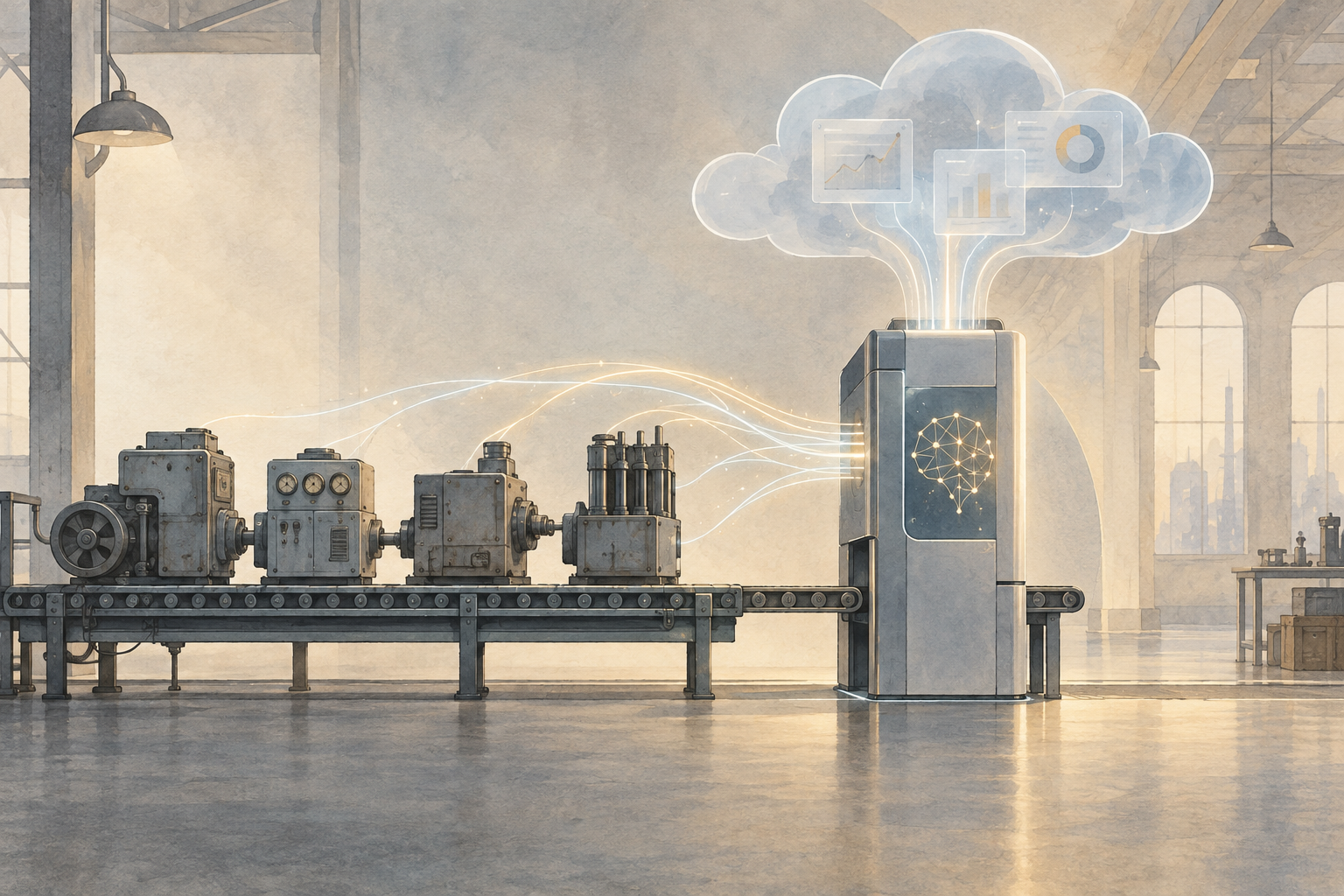
Siemens is reorganizing the core of its industrial automation franchise to convert deep factory relationships into higher-margin software and AI revenue. Starting October 1, four units inside Digital Industries will be combined into a single automation business, a Bloomberg-reported move meant to connect sales, technology and operating data that have sat in separate silos.1
The logic is straightforward but difficult to execute. Siemens already sells equipment into factories, buildings, grids and transport systems. CEO Roland Busch wants customers such as Boeing and Volkswagen to buy more of that stack through one channel — from plant electrification and machine controls to design and operating software — instead of treating Siemens as a collection of product businesses.2 If the company can simplify that experience, it may attach more software, analytics and AI services to the hardware base it already controls.
That makes the reorganization more than an internal reporting change. It is a strategic response to two pressures: software-first competitors trying to own the industrial data layer, and investors who still discount Siemens because of its complex conglomerate structure. Siemens has already spent more than $15 billion on software assets, including Altair and Dotmatics, and is building an AI hub in Seattle led by former Amazon Web Services executive Vasi Philomin.1 The new automation structure is the operating model Busch needs if those acquisitions are to lift returns rather than add complexity.
Digital Industries is Siemens’ most important arena for proving that industrial AI can generate durable economics. The October 1 consolidation puts four units into a single automation business, with the goal of linking hardware, software and operating data more tightly.3
The intended benefit is not just lower overhead. It is a more integrated selling model in which Siemens can package factory controls, engineering tools, data services and AI applications around customer workflows.
For large manufacturers, that could reduce vendor friction. A Boeing or Volkswagen plant does not buy automation in isolated categories. It has to design products, configure production lines, run machines, manage energy use and improve uptime. Siemens’ argument is that a single automation organization can offer a more coherent industrial system across those needs.1
For Siemens, the prize is a better revenue mix. Hardware sales tend to be cyclical, capital-intensive and exposed to factory investment cycles. Software, data services and AI applications can carry higher margins and more recurring revenue if they become embedded in design, simulation, operations and maintenance. The question is whether Siemens can shift from selling equipment plus tools to selling an integrated automation platform.
Industrial AI gives Siemens a credible reason to reorganize now. Its advantage is that it already has installed equipment and long-standing customer relationships in factories and infrastructure. Pure software providers may have stronger cloud-native economics, but they often lack direct access to machines, control systems and operating data. Siemens is betting that combining those assets will make its platform harder to replace.2
That defensive logic matters because factory software is becoming a contested layer. If independent software companies, hyperscalers or Chinese automation groups win the analytics and AI interface, Siemens risks being pushed into lower-margin equipment supply. If Siemens can use its installed base to capture real-time operating data and deliver AI-enabled optimization, it can defend its control layer while expanding into software economics.3
The Seattle AI hub and recent software acquisitions fit that strategy. Altair strengthens simulation and engineering software; Dotmatics adds scientific data and research software exposure. Together, they broaden Siemens’ ability to sell digital tools around physical assets.5 But the reorganization will determine whether those assets operate as one platform or remain adjacent businesses.
The financial stakes are visible in Siemens’ valuation. Bloomberg-cited analysis from UBS estimates that the discount investors once applied to Siemens because of its structure has narrowed from as much as 50% about three years ago to roughly 10% to 15%.1 That improvement suggests Busch’s simplification agenda has gained credibility. Closing the rest of the gap requires evidence that a simpler structure can produce faster growth and higher returns.
Margins are the harder benchmark. Siemens has become one of Germany’s most valuable companies, helped by its industrial AI narrative, but its profitability still trails European automation rival ABB and remains well below U.S. industrial technology group Honeywell, according to the Bloomberg report.4 That gap is why investors will judge the October 1 change by commercial outcomes, not organizational charts.
The near-term measures will be practical: higher software attach rates, more bundled automation wins, lower duplication in research and development, and evidence that customers use Siemens as a single industrial technology partner. Union Investment fund manager Jasmin Wolfram described the opportunity as both cost and revenue synergy if Siemens can scale R&D while selling hardware, software and services as an integrated system.2
Siemens has spent years reshaping itself by exiting or separating businesses including semiconductors, energy equipment and medical technology. The current phase is different. It is less about what Siemens owns and more about how the remaining businesses work together.3
That distinction matters for valuation. Industrial conglomerates are often penalized when investors struggle to compare them with focused peers. Siemens is trying to present itself less as a sprawling engineering group and more as a technology-led automation company with defensible data access. Market-focused commentary has framed software-based automation and industrial AI partnerships as part of the case for a higher future valuation multiple.6
But simplification carries execution risk. Combining units can clarify accountability, but it can also disrupt sales incentives, product road maps and customer relationships if mishandled. Siemens must make the new structure easier for customers to navigate while preserving the domain expertise that made each unit valuable.
The strongest version of Busch’s strategy would turn Siemens’ installed hardware base into a flywheel. Hardware creates data access. Data improves AI models and software tools. Better software deepens customer dependence. Deeper dependence supports recurring revenue and higher switching costs.
That flywheel is attractive because Siemens operates close to mission-critical production processes. In factories, automation software is not a discretionary app. It can influence uptime, quality, energy consumption and throughput. If Siemens can embed AI into those workflows, it can justify software pricing tied to productivity outcomes rather than one-off equipment sales.
Still, customers will not accept lock-in without clear operational gains. Manufacturers are under pressure from weak demand, high costs and more agile Chinese competitors, particularly in Germany’s core industrial base.3 They will evaluate Siemens’ integrated model on whether it improves performance, reduces complexity and lowers total cost of ownership.
The October 1 consolidation gives Siemens a clearer structure for its industrial AI ambitions. Success would mean customers increasingly buy automation as a connected system rather than as separate hardware and software components. It would also mean Siemens can show that AI is improving margins through repeatable software revenue, not just supporting a broad technology narrative.
The strategic direction is coherent. Siemens has the installed base, customer access and engineering credibility that software-only rivals lack. It has also invested heavily in software and AI capabilities. The unresolved question is whether Busch can make a 179-year-old industrial company operate with enough integration and speed to capture the value of those assets.
If he can, Siemens’ factory relationships with Boeing, Volkswagen and other large manufacturers could become the foundation for a more software-like automation business. If he cannot, the company risks owning valuable hardware positions while others capture the higher-margin intelligence layer above them.

Ecopetrol’s appointment of Joaquín Gutiérrez Caballero as permanent chief executive effective September 28 ends Camilo Barco’s interim tenure and gives the state-linked oil company a new mandate on governance, stakeholder confidence and strategy. The board’s unanimous decision comes as the company faces pressure over finances, production, reserves, gas supply and its role in Colombia’s fiscal and energy-security agenda.

Archer’s planned acquisition of Boeing’s Wisk Aero, Insitu and SkyGrid subsidiaries is less a pure air-taxi scale play than a bid to combine eVTOL hardware, unmanned aircraft and airspace intelligence into a broader aerospace autonomy platform. The antitrust waiting period has expired, but the strategic test is whether Archer can integrate assets that serve defense, autonomy and traffic-management markets before passenger air taxis become a mature business.

Iridium shareholders approved Rocket Lab’s planned acquisition on September 24, advancing a deal that would move Rocket Lab beyond launch and spacecraft manufacturing into ownership of an operating satellite communications network. The transaction still faces regulatory review, but it could give Rocket Lab a more credible integrated alternative to SpaceX’s launch-to-services stack.

Kuehne+Nagel’s expectation of double-digit growth in AI-linked data-center logistics through 2029 underscores a shift in freight forwarding from transactional shipping toward managed infrastructure delivery. Hyperscalers increasingly need partners that can coordinate vendors, customs, inventory and final-mile site delivery, not just secure transport capacity.
Digital Industries
Siemens’ major division focused on factory automation, industrial software, controls and digital manufacturing technologies.
Conglomerate discount
A lower valuation investors apply when a company’s complexity makes it harder to compare with focused peers or assess performance.
Software attach rate
The share of hardware or equipment sales that also include related software, subscriptions, data services or digital tools.
Industrial AI
AI applied to physical operations such as factories, grids, machines and transport systems to improve design, uptime, quality or efficiency.
Comments