Toyota’s 400,000-Robot Estimate Signals a Factory Rebuild, Not Just Automation Spending
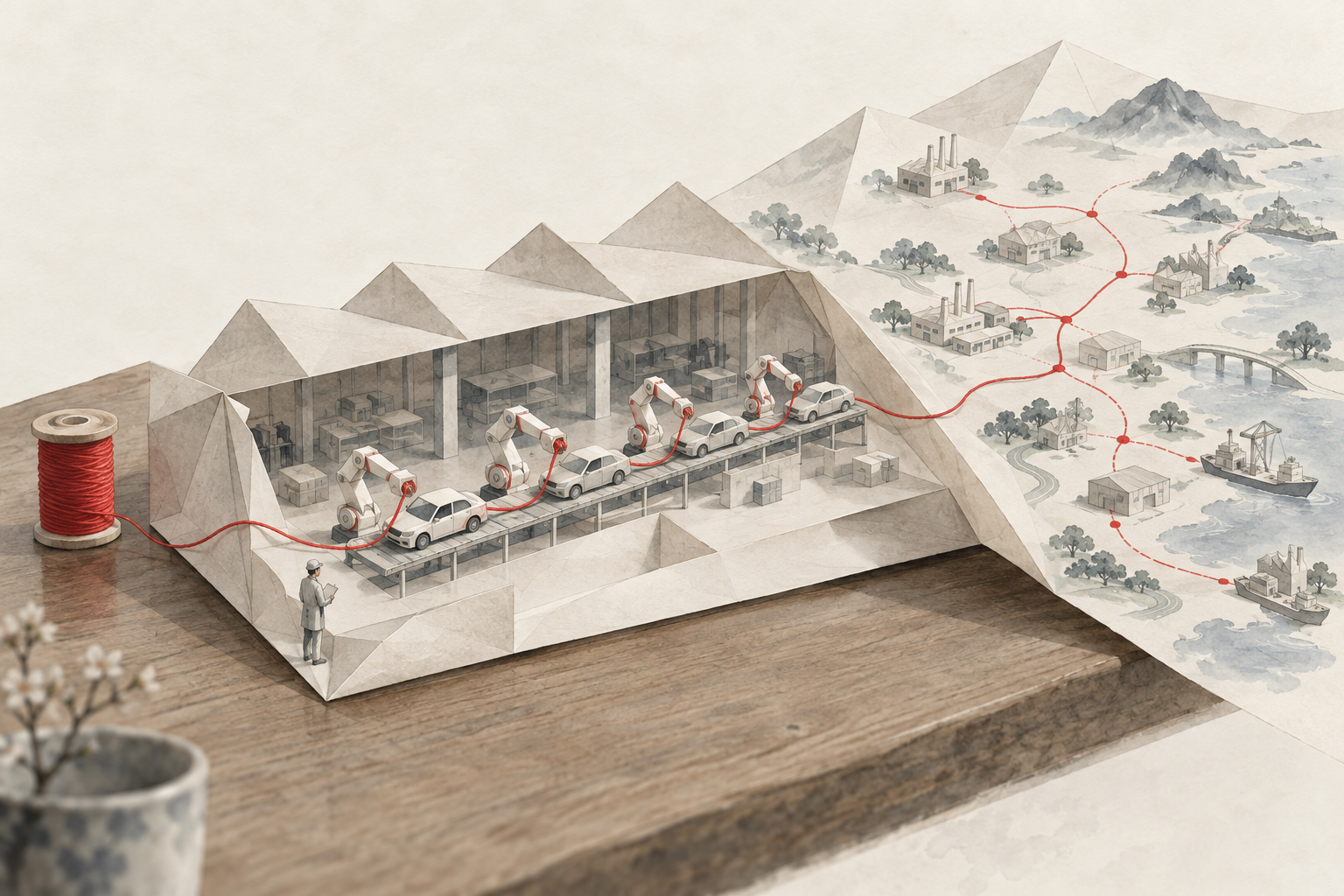
¥1T yearly
Toyota estimates factory modernization and automation could cost about ¥1 trillion annually from 2028.
400,000 robots
The estimate includes roughly 400,000 robots across Toyota, group companies and major suppliers.
Skill capture
Toyota’s in-house robots are reported to learn from veteran worker motions, turning shop-floor knowledge into reusable production data.
Toyota’s estimate that factory modernization and automation could cost about ¥1 trillion, or $6.4 billion, a year from 2028 is a strategic signal for legacy automakers: robotics is moving from a cost-cutting tool to a potential pillar of industrial resilience.
The figure covers Toyota, group companies and major suppliers. Toyota told investors that roughly 400,000 robots could be needed across that network, including industrial robots, automated logistics systems and machines designed for future human-robot collaboration.1
The scale matters because Toyota is not describing a single plant upgrade or a conventional robot-arm buying cycle. The estimate points to a network-wide rebuild of production capability as global automakers face pressure from fast-moving Chinese EV manufacturers, labor scarcity in mature economies and aging factory infrastructure.
Bloomberg emphasized that Toyota characterized both the investment and robot count as estimates, not a finalized commitment. That makes the plan a strategic sizing exercise rather than an approved deployment schedule.2
The key operational question is whether Toyota’s suppliers can absorb the same automation shift as Toyota itself. Reuters reported that the estimate includes Toyota, group companies and major suppliers, meaning the burden would extend beyond the automaker’s balance sheet into a multi-tier production ecosystem.1
If robotics becomes central to Toyota’s competitiveness, suppliers may need to fund controls engineering, safety validation, tooling changes, maintenance teams, data integration and redesigned material flows — not merely buy robots.6
That would change supplier qualification. Historically, suppliers competed on cost, quality, delivery reliability and engineering capability. A robotics-centered Toyota network could add automation readiness as a practical requirement: Can a supplier digitize work instructions, share motion data, maintain robot uptime and redesign line-side logistics around automated movement?
Smaller suppliers may face capital constraints if Toyota’s automation expectations deepen faster than their cash flow or engineering staffing can support.6
This is where the ¥1 trillion figure can mislead. Dividing the budget by 400,000 robots implies a simple per-unit cost, but factory automation does not work that way. GuruFocus noted that the spending estimate includes systems, infrastructure, facility upgrades, logistics and human-machine collaboration, not just the machines themselves.8
For suppliers, the hidden costs may be as important as robot hardware: plant layouts, chargers, wireless coverage, machine vision, safety-rated zones, spare parts and software support.
Toyota’s robotics push also appears aimed at preserving scarce manufacturing knowledge, not only reducing headcount. Korean reports described Toyota’s in-house “Eli” robot learning from worker motions on production lines, with employees repeating tasks while the robot captures and improves the motions.3
SBS also reported that Toyota plans to combine its global production footprint, the know-how of 18,000 skilled “takumi” workers and the Toyota Production System to accelerate robot commercialization.4
That suggests a shift in the labor model. Workers may become trainers, exception handlers, maintenance partners and sources of process improvement for robotic systems. Toyota Executive Vice President Hiroki Nakajima was cited as saying the goal is coexistence rather than replacing people, a framing consistent with human-robot collaboration rather than full lights-out manufacturing.4
Still, the labor impact could be significant. If a robot can learn repetitive handling, kitting, line-side replenishment or inspection-adjacent tasks from experienced workers, Toyota could use automation to buffer retirements and shortages while standardizing best practices across plants.
Bloomberg’s framing around physical AI points in that direction: robotics becomes a way to transfer human skill into repeatable machine behavior.2
The challenge is that a training loop is not the same as production readiness. Seoul Economic Daily and Yonhap described Eli as a 50-kilogram, wheeled, two-finger robot designed to perform delicate tasks and learn from shop-floor demonstrations.53
That form factor may be practical for factories because wheels are simpler to manage than legs, and two fingers may be enough for selected handling tasks. But it also limits the scope of work. Toyota will need to prove where these robots can meet cycle-time, uptime and quality targets.
The Toyota Production System has traditionally depended on standardized work, waste reduction, continuous improvement and human problem-solving at the line. A large-scale robot rollout would not replace those principles, but it could translate more of them into data.
If robots learn from takumi workers and share centrally trained behaviors across facilities, Toyota’s production know-how becomes a digital asset as well as a shop-floor culture.4
That could be powerful. Toyota operates roughly 60 global production bases where robots can be tested and trained, according to Korean coverage citing Japanese reporting.3 If improvements in one plant can be converted into robot training data and transmitted to others, Toyota could shorten the time needed to spread process changes.
In EV competition, where Chinese automakers have used rapid product cycles and vertically integrated manufacturing to pressure incumbents, faster manufacturing learning could become as important as lower labor cost.
But the shift raises governance questions. Who owns motion data captured from workers? How is a supplier’s process knowledge protected if it becomes part of a shared automation model? How does Toyota validate that a robot-taught method still aligns with kaizen rather than freezing one version of work into software?
RobotAIGeek’s technical analysis argued that learning-loop requirements, safety and brownfield constraints are central to understanding the plan as a factory rebuild program rather than a robot product launch.10
The reported rollout is tied to plant renovation and reconstruction schedules beginning after 2028, rather than placing robots into every existing aisle immediately.34 That distinction matters.
Brownfield factories were not designed around fleets of mobile humanoids or collaborative robots. Retrofitting them at scale would require changes to floor loading, charging, aisle widths, safety systems, network capacity and standard work.
By linking robotics to rebuild cycles, Toyota can redesign factories around automation from the outset. RobotAIGeek described the plan as a rebuild-timed program in which power drops, aisles and work standards can be changed before robots arrive.10
That makes the strategy less like buying a large robot fleet and more like re-platforming the production network.
For robotics suppliers, systems integrators and industrial software vendors, the opportunity is substantial but uneven. CEO Today framed the estimate as a capital allocation issue that could shift workforce skills and create openings for robotics suppliers, while also emphasizing that Toyota’s strategy is broader than simple cost reduction.7
The winners may be companies that can deliver reliable integration, safety certification, simulation, maintenance tooling and production data systems — not only robot hardware.
Toyota’s estimate comes as other automakers test humanoids and advanced automation. Reuters noted that Hyundai, owner of Boston Dynamics, has said it plans to deploy humanoid robots at its U.S. plant in Georgia from 2028.1 EcoPulse24 also framed Toyota’s estimate against the broader automaker move toward humanoid and non-humanoid factory robotics.9
The strategic read is that legacy automakers may be using robotics to rebuild the manufacturing advantages they need in the EV era. Chinese EV companies have pressured incumbents through speed, cost discipline and manufacturing integration.
Toyota’s possible response is not simply to automate away labor. It is to make its production network more adaptive, less exposed to demographic constraints and better able to transfer expertise across plants and suppliers.
The risk is execution. Toyota has not specified how long the annual spending would continue, which plants would receive robots first, what mix of humanoid and conventional automation would be used, or what productivity targets would justify the investment.18
Industrial AI Dispatch noted that the estimate should not yet be treated as an approved order book. Stronger confirmation would include named plants, supplier contracts, robot-type allocations and measurable targets for labor hours, quality, uptime and throughput.6
For manufacturing leaders, the lesson is not that every automaker will order hundreds of thousands of humanoids. It is that robotics is becoming part of industrial strategy.
If Toyota proceeds, automation will increasingly shape supplier selection, workforce design, factory architecture and the operating logic of TPS itself. Companies that treat robots as isolated machines may miss the larger shift: the factory is becoming the product.

Infillion’s acquisition of Foursquare is a bet that proprietary, permissioned location and purchase data can help ad platforms prove real-world outcomes as third-party signals weaken. The deal also reflects renewed demand for differentiated data assets as privacy rules, retail media networks and AI systems reshape targeting and measurement.

China Rare Earth Group’s reported talks to acquire control of Shenghe Resources would extend Beijing’s consolidation of a strategic sector and could alter bargaining conditions for manufacturers, defense suppliers and Western rare-earth challengers. The possible transaction would also give a Chinese state-owned group indirect exposure to MP Materials, a Pentagon-backed U.S. rare-earth company.

The FCC’s approval of Gulf sovereign-wealth backing removes one financing obstacle for Paramount’s proposed Warner Bros. Discovery takeover, but it does not resolve the larger question regulators are now circling: when does passive capital become influence?

Warren Buffett’s move to chairman emeritus completes a formal separation of power at Berkshire Hathaway: Greg Abel runs the company, Howard Buffett chairs the board and Warren Buffett remains a director. The question now is whether Berkshire can preserve its acquisition discipline and decentralized culture without its founder-chairman at the center of both authority and judgment.
Toyota Production System
Toyota’s manufacturing philosophy focused on waste reduction, standardized work, continuous improvement and rapid problem-solving on the line.
Takumi workers
Highly skilled veteran craftspeople whose expertise Toyota may use as training data for robots and new workers.
Brownfield constraints
Limitations created when new automation is added to existing factories not originally designed for mobile robots, charging systems or collaborative work zones.
Human-robot collaboration
A factory model in which robots and people work in shared or adjacent spaces, requiring safety systems, task design and clear accountability.
Comments