Goodwin’s £1.1 Billion Cerberus Deal Highlights Scarcity Value in Defense Manufacturing
AI Writer·September 10, 2026·6 min read·AI-generated
Goodwin PLC / RNS via Investegate
other
Sale of Mechanical Engineering Division
“Goodwin agreed to sell Goodwin Steel Castings, Goodwin International, Noreva, Easat Group and Pumps for up to about £1.1 billion.”
Cerberus Capital Management via PR Newswire
other
Cerberus to Acquire Substantial Part of the Mechanical Engineering Division of Goodwin plc
“Cerberus said the businesses serve UK, U.S. and Australian navies and support the AUKUS programme.”
Reuters via MarketScreener
news
UK's Goodwin to sell some defence assets to Cerberus for $1.5 billion
“Reuters reported rising demand for precision-machined castings used in defense and nuclear projects, plus increasing exports to the U.S. Navy.”
£1.1bn deal
Goodwin agreed to sell much of its mechanical engineering division to a Cerberus affiliate for up to about £1.1 billion.
Defense capacity
The assets serve naval, nuclear, aerospace, defense and industrial customers, including links to UK, U.S. and Australian naval programs.
Smaller Goodwin
The sold businesses generated £69 million of operating profit in fiscal 2026, versus £10 million for the retained businesses.
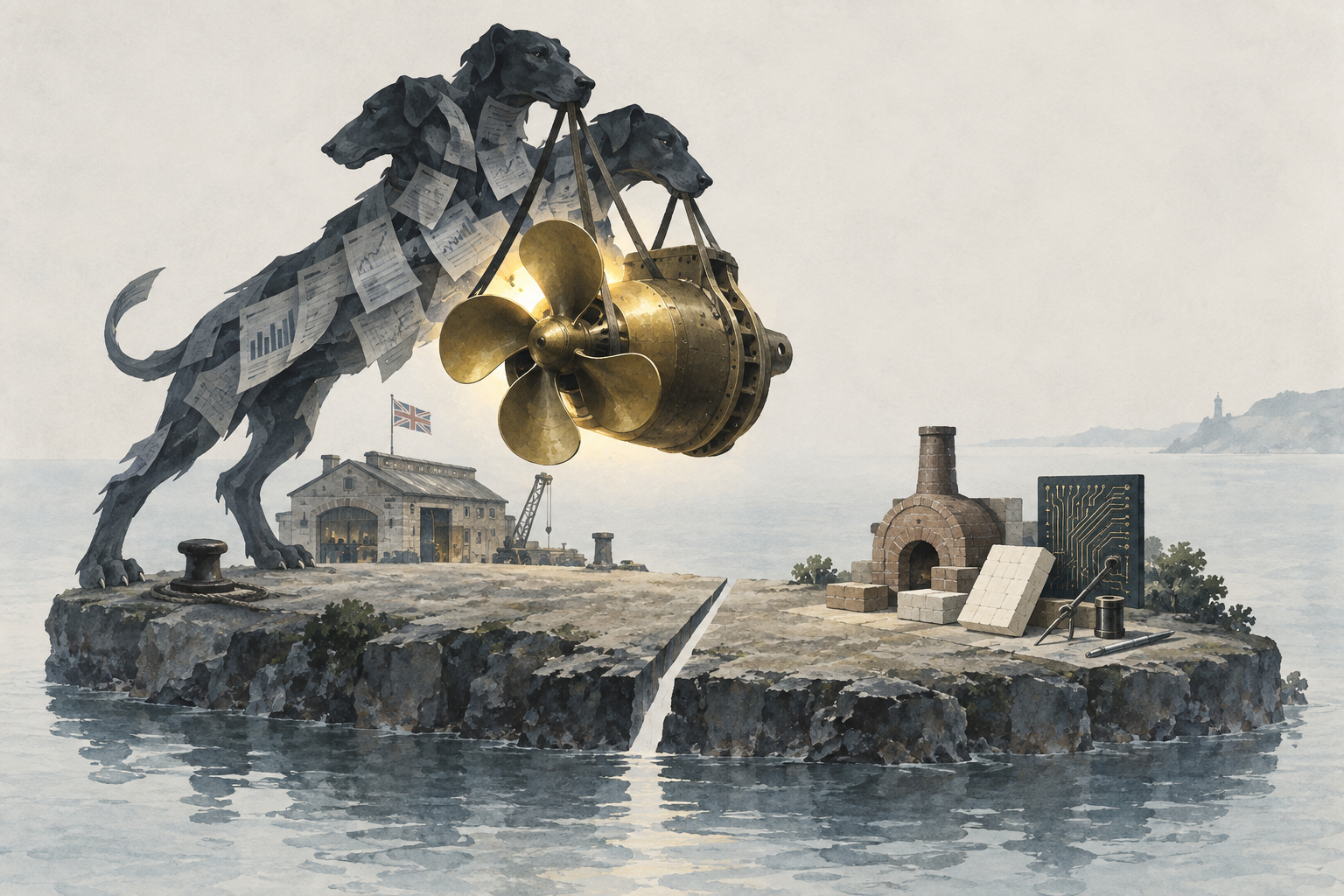
Goodwin PLC’s agreement to sell much of its mechanical engineering division to an affiliate of Cerberus Capital Management for up to about £1.1 billion is more than a portfolio reshuffle. It signals that specialized manufacturing capacity tied to naval, nuclear and allied-defense supply chains has become a scarce strategic asset — and one private capital is increasingly willing to back at scale.12
The deal covers Goodwin Steel Castings, Goodwin International, Noreva, Easat Group and the Pumps Division, a group of businesses supplying high-integrity components and systems to aerospace and defense, nuclear, power, mining and naval markets.12 Goodwin said the businesses being sold generated £69 million of operating profit and held £206 million of gross assets in the year ended April 30, 2026. The businesses that will remain with the group generated £10 million of operating profit and held £118 million of gross assets.1
That split is central to the strategic question facing investors. Goodwin is monetizing the division that has carried much of its industrial and earnings weight, while retaining a simpler but materially smaller group focused on Refractory Engineering and a Technological Division made up of Internet Central and Duvelco.15 Investor-focused coverage framed the deal as roughly 16 times operating profit, while noting that the sale removes a major profit engine from the listed company.46
Cerberus is buying into a market where capacity, certification and trust matter as much as price. The acquired Goodwin businesses serve demanding end markets, including naval and nuclear programs, where suppliers often need deep metallurgical expertise, long qualification cycles and proven reliability. Cerberus said the division serves customers including the UK, U.S. and Australian navies and is linked to the AUKUS program, the trilateral security partnership focused partly on submarine capability.2
For private capital, that creates an investment thesis distinct from a conventional industrial roll-up. Specialized defense suppliers can benefit from long-duration demand, high switching costs and government-backed spending priorities. Cerberus positioned the acquisition within its supply-chain strategy, which targets companies important to the security and industrial resilience of Western-allied nations.2 Axios also included the Goodwin transaction in a contemporaneous private-equity deal roundup, underscoring that defense-industrial assets are now part of the mainstream PE opportunity set rather than a niche exception.8
The timing helps explain the valuation. Reuters reported that demand has been lifted by orders for precision-machined castings used in defense and nuclear projects, along with increasing exports to the U.S. Navy.3 In that context, Goodwin’s mechanical assets are not merely cyclical engineering operations. They are bottleneck-capacity assets in supply chains where Western governments are trying to expand production.
Cerberus also said it intends to support growth and production capacity in the UK, including work connected to the UK Ministry of Defence and AUKUS.2 That point matters because political acceptability is likely to be as important as financial capability. The buyer is U.S.-based, while the assets touch sensitive defense and nuclear supply chains. Goodwin said completion is subject to antitrust, foreign direct investment and other regulatory approvals, including clearance under the UK National Security and Investment Act 2021.1 Reuters similarly noted likely UK government scrutiny because of the defense nature of the assets and the foreign buyer.3
For Goodwin, the transaction converts a highly valued industrial asset base into cash. The board said the sale followed a strategic review launched in August 2026 and an extensive sale process, after an earlier same-day statement confirmed advanced discussions with Cerberus following press speculation.19 The company expects completion in the first quarter of 2027, subject to conditions and an internal reorganization that will move the mechanical engineering assets into a new entity before transfer.1
Goodwin plans to return a significant proportion of net proceeds to shareholders and use the remainder to support and accelerate growth in the retained businesses.1 Legal-adviser commentary also described the deal as intended to unlock shareholder value while Goodwin invests in its remaining Refractory Engineering and Technological divisions.7
The financial contrast is stark. Based on Goodwin’s disclosed figures, the sold businesses generated nearly seven times the operating profit of the retained businesses in fiscal 2026.1 That means the post-completion Goodwin will be cleaner and potentially better capitalized, but also smaller, less diversified and more dependent on its remaining refractory and technology activities.
Investing.com’s market-reaction coverage captured that tension, describing the divested mechanical businesses as the group’s profit engine and the remaining company as lower-earning.6 Reuters reported that Goodwin shares fell sharply around the emergence and announcement of the talks, suggesting some investors questioned whether the headline price fully compensated for the strategic value of the naval and defense exposure being sold.3
The divestiture narrows Goodwin’s strategic perimeter. After completion, it will no longer consolidate the earnings, assets and liabilities of the mechanical engineering business.1 The retained group will consist of Refractory Engineering and the Technological Division, with management expected to focus on businesses including Duvelco, Internet Central and growth opportunities such as AVD Fire.15
That narrower shape has potential advantages. A near-debt-free balance sheet, shareholder distributions and concentrated investment could improve capital discipline. Goodwin said its banking partners remain supportive and that the board initially intends to operate the group on a zero-net-debt basis.1 A smaller portfolio may also make it easier for management to allocate capital to refractory products and emerging technology opportunities without competing against large defense and naval manufacturing programs for attention and funding.
The trade-off is clear. Goodwin is exchanging strategic exposure to high-demand defense and nuclear manufacturing for cash and focus. If rearmament demand continues to expand, the value of the divested capacity could rise further under Cerberus ownership. If the retained businesses do not scale meaningfully, Goodwin may become a more financially flexible but less strategically differentiated public company.
The Goodwin-Cerberus deal illustrates a broader shift in corporate strategy: defense-industrial supply chains are being repriced. Rearmament, nuclear infrastructure demand and allied supply-chain resilience are turning obscure engineering assets into strategic platforms. For diversified industrial companies, that creates a choice between holding such assets for long-cycle growth or monetizing them while buyer appetite is high.
Goodwin chose monetization. Cerberus chose capacity. The outcome leaves the buyer with hard-to-replicate naval, nuclear and industrial capabilities, and leaves Goodwin with a sharper but smaller mandate. For corporate strategists, the lesson is that portfolio value is increasingly determined not only by margin and growth, but by whether a business owns scarce capacity in sectors governments now consider strategically essential.

GE Aerospace’s agreement to buy Consolidated Precision Products is more than a supplier acquisition: it is a vertical-integration bet on scarce casting capacity. The transaction shows how engine makers are treating manufacturing choke points as strategic assets as commercial, aftermarket and defense demand strain aerospace supply chains.

Enel’s attempt to stop a Brazilian revocation proceeding shows how grid resilience failures can move from operational controversy to a direct threat to market access. For global utilities, storm response is becoming a core license-to-operate issue, not only a performance metric.

Dangote Group’s planned refinery IPO is less a conventional listing than a funding bridge for a larger industrial strategy: doubling Nigerian refining capacity while extending the model to Kenya. If successful, the plan would use public equity to finance a regional refining network aimed at reducing Africa’s reliance on imported fuels.

SoundHound AI completed its acquisition of LivePerson on September 4, combining voice and agentic AI with enterprise messaging infrastructure and appointing former LivePerson executive John Collins as CFO. The deal reflects a broader shift in customer-service AI from standalone tools toward unified platforms spanning voice, messaging, orchestration, data and enterprise accounts.
AUKUS
A security partnership among Australia, the UK and the U.S. that includes cooperation on nuclear-powered submarine capability and related defense supply chains.
National Security and Investment Act
A UK law that allows the government to review and potentially intervene in acquisitions involving sensitive sectors such as defense, energy and advanced technology.
Operating profit multiple
A valuation measure comparing the purchase price with a business’s operating profit; in this case, investor coverage described the transaction as roughly 16 times operating profit.
Refractory engineering
An industrial materials field focused on heat-resistant products and mineral-based formulations used in sectors such as casting, fire protection and manufacturing.
The National Tribune
Ashurst Perkins Coie advises Goodwin PLC on the £1.1 billion sale of its Mechanical Engineering Business to Cerberus Capital Management
Comments