Mexico’s expected Viva Aerobus-Volaris approval would hinge on fares, jobs and routes
Reuters via Investing.com
news
Exclusive-Mexico to approve Viva-Volaris airline merger by end of 2026, sources say
El Economista / Reuters
news
La Comisión Nacional Antimonopolio aprobará la fusión Viva-Volaris antes de fin de año
UnoTV / Reuters
news
Fusión de Volaris y Viva se concretaría en recta final de 2026, reporta Reuters
Year-end approval
Reuters reported that Mexico’s antitrust authority is expected to approve the Viva Aerobus-Volaris merger by the end of 2026.
Core remedies
Expected conditions include accessible fares, no mass layoffs and preservation of most existing routes.
Market concentration
The combined airline group could account for about 73% of Mexico’s domestic passenger traffic.
Mexico’s antitrust authority is expected to approve the planned merger of Viva Aerobus and Volaris by the end of 2026, Reuters reported on October 13. The decision would likely create the country’s largest airline group and test how far regulators are willing to accept consolidation in a market with limited competitive alternatives.1
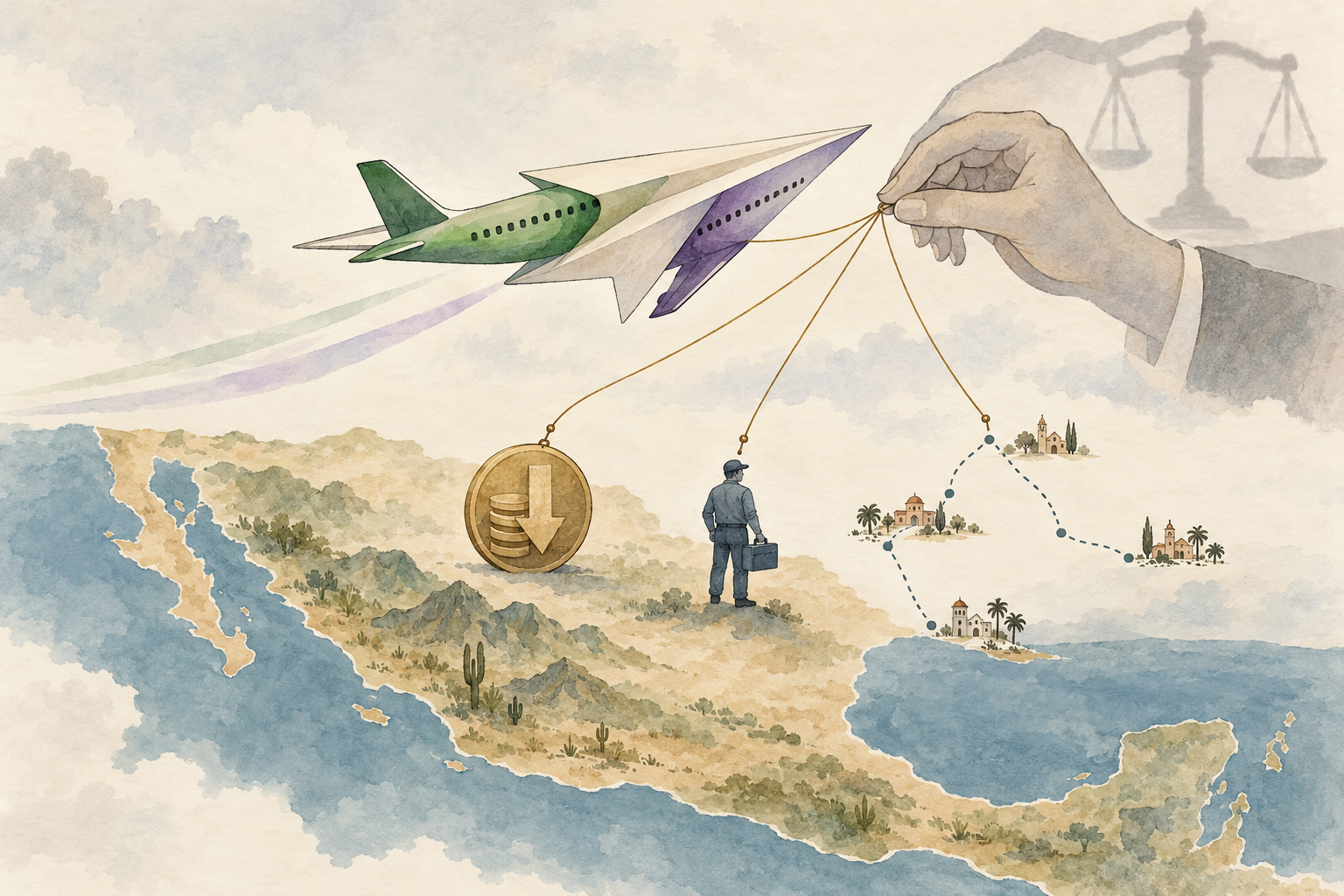
Approval is expected to include operating conditions in three areas: keeping fares accessible, avoiding mass layoffs and preserving most existing routes, according to Reuters reporting republished by Mexican outlets.13 Those commitments would be central to the regulator’s case that a larger low-cost airline group can be allowed if it maintains price discipline and network stability for consumers.
The proposed tie-up would combine Mexico’s two largest ultra-low-cost carriers after capacity constraints, airline failures and airport-policy shifts have already reshaped the country’s domestic aviation market. Mexico News Daily reported that the combined group could control about 73% of domestic passenger traffic, raising concerns among airports, corporate travel buyers and tourism markets that rely on frequent low-fare service.4
Reuters reported that the Comisión Nacional Antimonopolio is preparing to approve the deal before year-end, citing six sources familiar with the process.1 The expected remedies would not simply be formal divestitures or one-time concessions. Instead, they appear likely to create continuing operating obligations for the combined carrier.
The most important condition is expected to be a commitment to preserve the low-cost fare model. Mexican reports based on Reuters said regulators are considering fare benchmarks and tariff monitoring to ensure the merged airline does not use its expanded scale to raise prices on routes where competition is reduced.27
For travel and transport executives, that would make post-merger compliance a commercial issue, not just a legal one. Network planning, ancillary-fee strategy and revenue management would all face closer scrutiny.
A second expected condition is labor stability. Reports said the authority is likely to require the companies to avoid mass layoffs after the combination.13 That requirement would be intended to reduce political and operational risk in a merger involving overlapping functions, fleets, airport operations and corporate teams.
A third condition would require the merged carrier to maintain most existing routes. Reuters-based coverage in Mexico said route continuity is expected to be a core remedy, particularly where the two airlines are important providers of point-to-point service beyond Mexico City.36 Such a condition could limit the merged group’s ability to quickly rationalize frequencies or exit thinner markets after closing.
The central antitrust question is whether regulators can protect consumers through behavioral commitments in a market where the merged airline would have few comparable low-cost rivals on many city pairs.
El Economista, citing Reuters, reported that overlapping routes and potential airport-slot remedies are among the issues under review.2 Crónica de Xalapa reported that the merged group would be the sole operator on 55 routes, underscoring why route-by-route analysis is likely to matter more than national market share alone.7
A21, an aviation-sector publication, warned that the merger could weaken fare and frequency competition while increasing the combined airline’s bargaining power with airports.5 That concern is especially relevant for regional airports that depend on low-cost carriers to sustain passenger volumes, commercial revenue and air-service connectivity.
The expected approach suggests regulators may be trying to balance two risks. Blocking the deal could preserve nominal competition but leave both carriers exposed to cost pressures and infrastructure constraints. Approving it without meaningful conditions could create a dominant low-cost group able to set prices and schedules with limited competitive pressure on some routes.
Approval may also be tied to service commitments at Felipe Ángeles International Airport and Tulum’s newer airport, according to Mexican reports based on Reuters.26 Those commitments would align the merger review with broader government aviation priorities, including increasing traffic at alternative airports and expanding connectivity outside saturated hubs.
For executives, the regulatory package could affect airport negotiations well beyond Mexico City. If the combined airline must maintain or add service at specific airports, airport operators may gain short-term traffic certainty while facing a stronger counterparty in commercial negotiations.
Slot remedies could also be considered where capacity constraints create barriers to entry.2 However, slots alone may not solve the broader problem if few airlines have the fleet, cost structure and appetite to enter affected routes. That is why fare monitoring and route-continuity commitments appear likely to carry more weight than traditional structural remedies.
The Viva Aerobus-Volaris review is emerging as a test of whether Mexico will accept national airline consolidation if the companies commit to consumer-facing safeguards. The expected decision would signal that regulators are open to scale in aviation, but only if the merged carrier can show that low fares, employment stability and broad network access will continue after closing.
For the companies, approval could come with years of oversight. Fare commitments may require benchmarking against historical prices or comparable markets. Route obligations could constrain capacity planning. Employment protections could limit early cost synergies. Together, those conditions may reduce some of the transaction’s financial upside while making approval more politically and economically defensible.
For competitors, the decision could reshape entry calculations. A merged Viva-Volaris group would likely have greater fleet scale, brand reach and airport leverage, making it harder for smaller carriers to challenge it on price. But if regulators enforce fare caps, route obligations or slot access, rivals may find targeted openings on business-heavy or underserved routes.
For airports and tourism destinations, the key issue will be whether route-continuity commitments are specific, measurable and long enough to support planning. General promises to maintain service may offer limited protection if the merged airline can later reduce frequencies, change schedules or shift capacity to higher-yield markets.
No final approval has been announced. But if Reuters’ reporting is borne out, Mexico’s antitrust authority will be choosing a managed-consolidation model: allowing the country’s two leading low-cost airlines to combine while trying to preserve the consumer benefits that made them central to Mexico’s domestic travel market.14

Apple supplier Jabil and Adani Enterprises have signed a non-binding framework for a proposed equal joint venture to make AI and data-center equipment in India. The plan links global contract-manufacturing expertise with Indian infrastructure capacity, but its success will depend on whether India can build a deeper supplier base for high-value data-center systems.

Workday’s agreement to acquire C1.ai signals a broader push to make identity governance, permissions and audit trails foundational to how companies deploy AI agents across HR, finance and IT. The bet is that as agents proliferate, the system that controls what they can access and prove becomes as strategic as the agents themselves.

Humana is bringing in BlackRock’s HPS Investment Partners to replace WCAS in a joint venture covering nearly 150 CenterWell Senior Primary Care clinics. The structure lets Humana keep operating control while using outside capital to scale a clinic platform that increasingly resembles healthcare infrastructure.

LSEG’s confirmed talks to buy Permira-owned Octus for about $3.5 billion underscore a broader push by exchanges and financial-data groups into specialist subscription platforms. The potential deal would deepen LSEG’s fixed-income and private-markets data franchise, but it also raises execution and valuation questions under activist scrutiny.
Behavioral remedies
Merger conditions that require companies to act in certain ways after approval, such as maintaining routes, limiting fare increases or protecting jobs.
Ultra-low-cost carrier
An airline model built around low base fares, high aircraft utilization and extra charges for optional services such as bags or seat selection.
Slot remedies
Competition measures that require airlines to give up takeoff and landing rights at constrained airports so rivals can enter or expand service.
Route continuity
A commitment to keep serving existing city pairs, often to prevent a merged airline from cutting flights after competition is reduced.
Comments