Stryker names insider Spencer Stiles CEO to extend acquisition-led growth
CEO transition
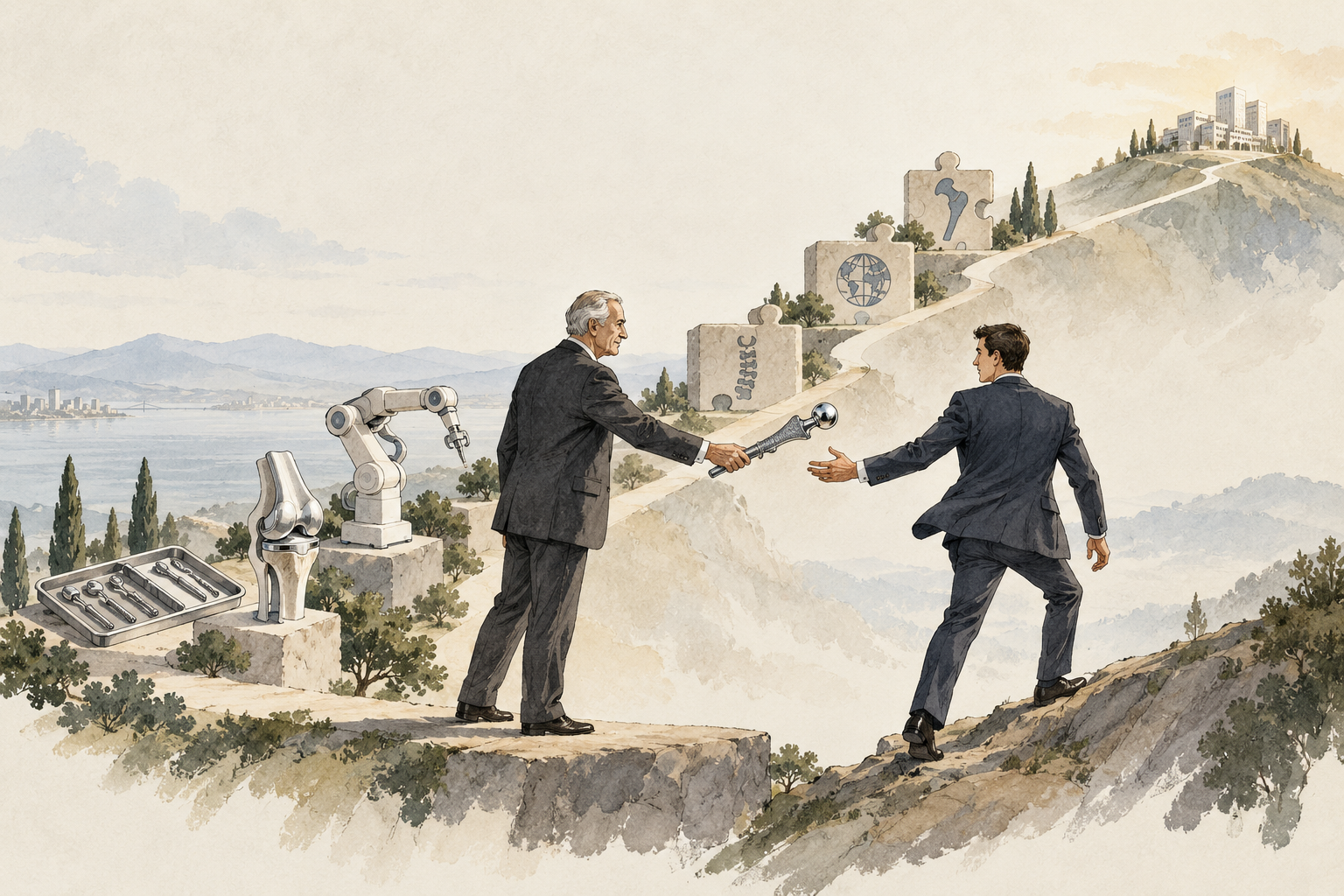
Kevin Lobo will become executive chair on January 1, 2027, while Spencer Stiles takes over as Stryker CEO.
Growth engines
Stiles has overseen orthopedics, digital robotics and enabling technologies, and mergers and acquisitions.
Deal history
Stryker completed more than 60 acquisitions during Lobo’s tenure as CEO.
Stryker is handing its chief executive role to an internal successor with direct oversight of several businesses and dealmaking levers that have shaped the medical technology company’s expansion.
The Kalamazoo, Michigan-based company said October 6 that Kevin Lobo will become executive chair on January 1, 2027, and President and Chief Operating Officer Spencer Stiles will become CEO the same day.1 The move positions Stiles, a longtime Stryker executive with responsibilities spanning orthopedics, digital robotics and enabling technologies, and mergers and acquisitions, to steer the company’s next phase of growth. Stryker completed more than 60 acquisitions during Lobo’s tenure as CEO.1
For healthcare business leaders, the succession underscores a strategic choice: Stryker is opting for continuity rather than a reset. Its next CEO will be expected to protect the operating model that helped turn the company into one of medtech’s most aggressive consolidators, while proving the business can keep expanding as acquisitions become larger, integration demands intensify and hospitals continue to scrutinize capital spending.
Stryker framed the transition as a planned succession. Lobo, who has led the company since 2012, will remain closely involved as executive chair, giving Stiles continuity at the board and strategic levels.1
In a regulatory filing, Stryker said its board will expand and documented Stiles’ appointment as CEO, Lobo’s transition agreement and Stiles’ compensation arrangements for the new role.2 The SEC filing index confirms the October 6 filing date and related exhibits, including the press release, transition agreement and Stiles letter agreement.3
The structure suggests Stryker wants to preserve stability during a leadership change at a time when its growth story is tightly linked to disciplined execution across multiple markets. Lobo’s continued role as executive chair may also reassure investors, customers and acquisition targets that Stryker’s board is not moving away from the strategy that defined his tenure.
That continuity was a central theme in early market reaction. MedTech Dive reported that analysts viewed Stiles as a known internal successor and emphasized the limited disruption expected from the handoff.4 Needham reiterated a Buy rating after the transition plan, citing the internal development path and investor implications of a leadership change that keeps Stryker’s strategic direction intact.8
Stiles’ résumé is significant because it overlaps with the businesses most important to Stryker’s future. Stryker said he has held responsibility for orthopedics, digital robotics and enabling technologies, as well as mergers and acquisitions.1 Those areas sit at the center of the company’s competitive position in procedural innovation and hospital relationships.
Orthopedics remains a flagship market for Stryker, and robotics has become a core differentiator in joint replacement. ORTHOWORLD noted that Stryker’s rise in orthopedics has been closely tied to Mako, the company’s robotic-arm assisted platform, and to major transactions such as Wright Medical.5
Stiles’ experience overseeing orthopedics and enabling technologies gives him operational familiarity with the platforms Stryker uses to deepen surgeon loyalty and defend premium positions in competitive implant markets.
His M&A responsibilities are equally important. Stryker has used acquisitions to enter or expand in high-growth categories, add technology platforms and broaden its presence across hospital and outpatient care. Under Lobo, the company completed more than 60 acquisitions, according to Stryker’s announcement.1 MedTech Dive highlighted deals including Wright Medical, Vocera and Inari Medical as examples of the company’s acquisition history and investor focus.4
The central question for Stiles will be whether Stryker can keep compounding growth from a larger base. Becker’s Spine Review reported that Stryker’s sales rose from $8.7 billion in 2012 to more than $26 billion in 2026, while also noting the company’s 60-plus acquisitions during Lobo’s tenure.6 That scale gives Stryker more commercial reach, but it also raises the bar for future deals and organic growth.
The company’s recent history shows how acquisitions can shape product portfolios and strategic options. The Wright Medical acquisition strengthened Stryker’s position in extremities and orthopedics, while Mako helped make robotics a prominent feature of its joint replacement strategy.45 Vocera added communications and workflow technology, broadening Stryker’s exposure to hospital digital operations.4 Inari Medical added another growth platform, reflecting Stryker’s willingness to pursue sizable targets beyond traditional orthopedic implants.4
But acquisition-led expansion brings tradeoffs. Larger deals can be harder to integrate, may face greater regulatory and valuation scrutiny, and can create expectations for ongoing revenue and margin contribution. As CEO, Stiles will have to balance the pursuit of new platforms with execution in Stryker’s existing businesses, including orthopedics, surgical equipment, neurotechnology and medical-surgical products.
Stryker’s choice of successor also points to the strategic importance of robotics and enabling technologies. Hospitals and ambulatory surgery centers are weighing investments in robotic systems, data tools and procedure-enabling platforms that can affect surgeon preference, case efficiency and implant pull-through.
Mako has become one of Stryker’s most visible technology assets in orthopedics. ORTHOWORLD described Mako’s role in robotic joint replacement and connected the platform to Stryker’s orthopedic momentum.5 For Stiles, the question is not only whether robotics can continue to support implant share, but also how Stryker can extend enabling technologies into broader procedural ecosystems.
That focus matters because medtech companies increasingly compete on integrated solutions rather than standalone devices. Systems that combine implants, instruments, imaging, software, robotics and data can create stickier customer relationships. They can also require heavier investment, training and service infrastructure, putting more pressure on execution.
Financial markets are likely to judge the new CEO on two related measures: whether Stryker can sustain above-market growth and whether it can continue acquiring without eroding returns. StreetInsider’s coverage of the succession highlighted the company’s acquisition-led growth and Stiles’ previous oversight of Wright Medical and the spinal implants separation.7 Investing.com reported that Needham’s reaction focused on the implications of continuity and Stiles’ internal development path.8
That combination places Stiles in a familiar but demanding position. He inherits a company with strong market positions, a deeply established acquisition playbook and a board chair who led Stryker through a major period of expansion. He also inherits the challenge of proving that the same playbook can keep working at greater scale.
Stryker’s succession plan gives it a relatively smooth leadership bridge. Whether it becomes a growth bridge will depend on Stiles’ ability to convert the company’s orthopedic, robotic and dealmaking strengths into durable performance after one of the most active acquisition eras in medtech.

SAP’s planned acquisition of TechWolf shows how the company is shifting its AI strategy from general-purpose assistants toward enterprise systems grounded in proprietary business and workforce context. The deal would add skills intelligence, work data and AI models to SAP SuccessFactors and Joule.

Informa’s £2.24 billion agreement to buy Clarion from Blackstone, paired with a plan to separate Taylor & Francis, recasts the group around higher-growth B2B live events. The transaction signals a sharper capital-allocation framework: build scale in exhibitions, and move slower-growth publishing into a structure better suited to its own market.

Uber agreed to acquire workplace catering platform ezCater for $2.3 billion in cash, extending Uber Eats beyond consumer takeout into recurring corporate meal programs. The deal gives Uber a larger foothold in scheduled, higher-value business orders as it competes with DoorDash for enterprise food spending.

Paramount’s completed takeover of Warner Bros. Discovery creates a Hollywood and news giant called Skydance, led by David Ellison with Ynon Kreiz as co-CEO. The immediate challenge is integrating studios, streaming, CNN and CBS while satisfying regulators and insulating newsrooms from political pressure.
Executive chair
A board leadership role that can keep a former CEO involved in strategy and governance after stepping out of day-to-day management.
Mako
Stryker’s robotic-arm assisted platform used in joint replacement procedures and a key part of its orthopedic technology strategy.
Acquisition-led growth
A strategy in which a company expands by buying other businesses, technologies or product lines in addition to growing existing operations.
Enabling technologies
Tools such as robotics, software, imaging and data systems that support medical procedures and can strengthen device platforms.
Comments